European Commission: Climate gains start with the initial design choices
October 9, 2026Building Paris Proof starts with the choices you make at the beginning of a project. New European research underscores that this is precisely where opportunities lie to reduce both CO₂ emissions and costs. For NICE, this confirms the approach that served as the starting point for SAWA.
The European Commission recently shared the results of INDICATE LIFE, a European program working to develop reliable data and methods for measuring the climate impact of buildings over their entire life cycle. The analysis of 41 case studies does not support the assumption that low-carbon buildings are inherently more expensive.

Early Focus on Material Impact
The projects studied show that cost savings are linked to early-stage design optimization, reduced material use, reuse, and prefabrication. The structural framework, foundation, and floors, in particular, account for a significant portion of material-related CO₂ emissions. The greatest opportunities arise before the key design decisions are finalized.
For NICE, this underscores an important principle: building in a “Paris Proof” manner does not necessarily have to be more expensive. By taking material impact into account from the very first sketch, we can weigh design, construction, and financial feasibility in a holistic manner.

SAWA as a real-world example
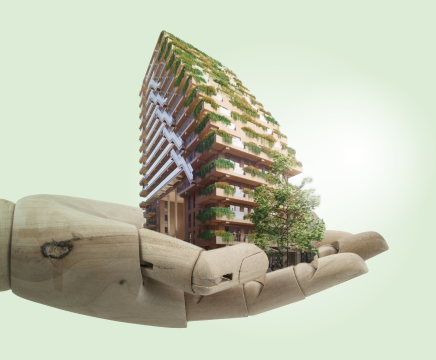
At SAWA in Rotterdam, that idea served as the starting point. With a wooden support structure, limited use of concrete, reused roof gravel as fill material, and mechanical, detachable connections, the project was designed from the outset to minimize material impact and facilitate future reuse.
Furthermore, the development and implementation of SAWA have led to NICE’s circular timber construction system. This allows us to apply the knowledge we’ve gained and proven solutions to future projects.
Understanding the entire life cycle is becoming the norm
Starting in 2028, the full life-cycle climate impact must be calculated and included on the energy performance certificate for new buildings larger than 1,000 m². Starting in 2030, this requirement will apply to all new construction in the European Union.
This makes it increasingly important to understand the implications of design and material choices from the very beginning. For NICE, this is already part of its development approach: focusing on CO₂ early on, in conjunction with quality, affordability, and feasibility.