Frequently Asked Questions
NICE has the answer
Below you can read our answers to frequently asked questions about our methods, vision and products, among other things. Is your question not listed? We are happy to receive it by e-mail.
NICE Developers
-
What distinguishes NICE Developers is the decisiveness to actually take a different approach to the development process and the willingness to sacrifice part of the profit to do so. The result is expertise in the field of wood and circular (certified) construction.
-
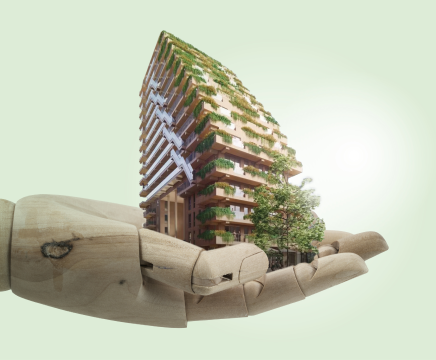
The NICE Concept enables NICE Developers and its clients to build for change. The development of these Paris Proof buildings reduces CO2emissions because the building materials are as bio-based as possible, are 'harvested' from existing buildings and because the buildings are circular (detachable). A NICE Building enhances biodiversity and climate adaptability, offers a better mix of social rental, mid-rent and owner-occupied housing and, finally, contributes to more meeting and connection within the residential building and in the neighborhood. In this way, NICE Developers creates a positive impact on the community, people and the climate in order to permanently improve the world. The award winning SAWA is the ultimate proof that it is possible to build in an innovative way.
-
Climate change is a fact, as is the rapid decline of biodiversity. These developments will eventually affect us all. Action is needed now if we are to turn the tide. Unfortunately, change is not happening fast enough. Many put the need for change on the agenda, but concrete action often fails to materialize. Why is that? There is too little movement in the construction sector to innovate and the sector is not sufficiently forced to reduce CO2-emissions and innovation. While traditional building products such as concrete and steel account for about 10% of national CO2-emissions. This is going too slowly for NICE. NICE is taking matters into their own hands and causing change from the bottom up, by doing it themselves and causing change where they can do it best: in the development and construction industry. Change is not only necessary, but achievable in this sector. We just have to do it now!
Want to know more? Milieucentraal explains it well here exactly what the effects of climate change are.
-
This succeeds NICE Developers, simply because they think it's incredibly important. Why? Because the earth is becoming depleted. And because by recycling CO2-emissions. Where there is a will, there is a way: NICE is innovative, perseveres and ensures that the "harvested," reusable material is applicable, with certification if necessary.
-
People and companies have a natural resistance to change. Many developers and builders therefore choose the beaten path: the path they already know, rather than the undiscovered paths of innovation. National building regulations do not enforce this either. As a result, many parties unfortunately still build "traditionally" with concrete. While so much more is possible on the way to a healthy and Paris Proof living environment for current and future generations.
In addition, there are many myths surrounding circular and wood construction that may deter interested parties. Wood construction is said to be riskier and much more expensive and complex, as is its maintenance. NICE debunks these myths. Cold feet are understandable, but unnecessary.
NICE Concept
-
What distinguishes the NICE Concept is the combination of a proven prefabricated and circular system.
- The innovative Paris Proof approach has been adopted and has proven itself;
- The modular concept is reproducible and allows timber construction up to 100 meters;
- The floors - constructed of Cross Laminated Timber - are provided with dry ballast instead of concrete, making the building components reusable (circular). And making CO2 remains stored much longer;
- A NICE Building is more than just wood construction. It is also circular. And inclusive and friendly to people and animals. And climate-adaptive. And...
-
NICE Buildings provide CO2-reduction:
- Wood stores CO2 up, concrete emits CO2 out. NICE Buildings have an all-wood main supporting structure and thus contribute to CO2-storage;
- Many recycled materials are used in the construction of NICE Buildings. Materials that are therefore not remanufactured, reducing CO2 is emitted than if it were;
- NICE Buildings' CLT floors are provided with dry ballast instead of wet concrete. This makes the building components detachable and reusable. By creating buildings whose materials can be reused after their useful lives, we reduce future CO2-emissions;
-
The NICE Concept is a solid investment for several reasons, namely:
- The demand for Paris Proof buildings is already high and this need is only expected to grow due to future (international) laws and regulations;
- This is a wood building system, already used at SAWA, whose technology is proven;
- Construction costs are competitive with traditional concrete construction;
- Maintenance costs are market-based;
- Interest rates on this innovative building concept are at a lower level than for traditional construction, making mortgage loans cheaper;
- The concept is not only a wise investment for the client/investor, but also contributes to the interests of current and future generations because the concept is Paris Proof and meets sustainable objectives;
- In short: as an investor, you benefit from added value in the broadest sense.
-
The NICE Concept does not automatically guarantee the feasibility of social, mid-rent and buy in one residential building. The mission and vision are responsible for this. NICE Developers believes it is important to create affordable, Paris Proof housing and is willing to sacrifice part of the profits to make this possible. This has nothing to do with the technical system, but everything to do with the ambition behind it. A little less profit, for a higher added value: quality, affordable and future-proof housing for everyone.
-
The abbreviation CLT stands for Cross Laminated Timber. It is cross-laminated single-ply planks placed at right angles to each other and used as a building material. This reduces the action of the wood and creates a rigid and dimensionally stable wood product, suitable for floors, walls and roofs. CLT is very stable and can absorb significant forces. Glulam is also laminated lumber, but slightly different. With Glulam, the wood is not cross-glued, but the wooden planks lie in the same direction. This creates very strong beams with which you can bridge large spans. We use Glulam for wooden columns and beams. In the NICE Concept, CLT and Glulam are the main materials for the wooden main supporting structure. The wood itself is certified and comes from sustainable, European forests.
Did you know that: one cubic meter of CLT reduces 2 tons of CO2!
SAWA
-
SAWA is called "the healthiest building in the Netherlands" because it contributes to a healthy future in several ways:
- Many people are simply looking for housing, and NICE Buildings meet the housing need that is so primary. But not only that. Because a NICE Building also contributes to a better climate, residents not only get a home, but a living environment that provides everything they need for a healthy and happy foundation.
- Living in an apartment made of wood provides a pleasant indoor environment (acoustics, smell) and therefore contributes to a greater sense of well-being (also read: white paper 'More wood, more health')
- Generous outdoor communal spaces promote meeting and connection, leading to a greater sense of happiness;
- Wood construction increases CO2-storage;
- The (certified) wood used comes from sustainable forests with a CO2-neutral production. Additional trees are planted back with each logging, for more CO2-storage;
- Recycling contributes to CO2-reduction;
- SAWA is built detachable, thus circular in design, which contributes to CO2-reduction;
- There is a lot of greenery in, on and around the building, which increases CO2-storage, better living conditions for humans and animals, and motivation to exercise more;
- With CLT you build up to 50% faster than with traditional construction techniques, reducing (construction) inconvenience to the neighborhood.
-
Everyone deserves a good, healthy home, not just those who can afford it financially. So NICE Developers is working on Paris Proof residential buildings that bring together a variety of housing (social rent, mid-rent and owner-occupied) and diverse people, with diverse needs and financial capabilities. The common denominator? All are committed to a good, healthy neighborhood and city and are open or see the added value of meeting, connecting and community.
-
During the design phase (Mei architects and planners), careful thought was given to the distribution of housing and the communal spaces that serve as meeting places for residents (and local residents). During and prior to the development phase, NICE Developers is in close contact with both (potential) new residents and local residents, asking about needs, concerns and wishes, in order to then discuss the plans. In order to guide this process as optimally as possible at SAWA, NICE Developers also takes care of the property management after delivery.
-
SAWA is the first all-wood and circular 50-meter-high residential building in Europe. It was designed from the drive to develop a zero-carbon building, in response to the climate crisis. A building that for a healthy future. The realization of SAWA marks an important step toward international sustainability goals and proves that construction can be different. This pioneering approach is recognized and awarded!
Following SAWA's success at the World Architecture Festival, the Architecture Masterprize, MIPIM / Architectural Review Future Project Awards, Iconic awards for Innovative Architecture and Green Good Design Awards, among others, the SAWA team picked up two prestigious international architecture awards in Paris in late 2023. SAWA became the winner in the Green Architecture category and also the Popular Choice winner of the 2023 Architizer A+ Sustainability Awards. These awards are reserved for projects that excel in courage, diversity and excellence.
Why SAWA is garnering so much attention internationally? You can see that in the video below from The Financial Times. Senior editor Leyla Boulton came to Rotterdam to see SAWA and spoke to Mark about NICE Developers' approach. Watch the video here.
Timber Construction
-
A building made of wood, like any other building, must comply with regulations. So does a NICE Building. In the Netherlands, all this is laid down in the Bouwbesluit. The Bouwbesluit assumes that a 'carbon crust' forms on the wood in case of fire, after which the fire stops. To verify this assumption in the Building Code, SAWA was further investigated. This led to the decision to take an additional measure - on top of the Building Code - for extra safety. All homes are therefore equipped with sprinklers.
-
The Building Code includes requirements regarding noise and vibration. A wooden building, like a concrete building, must meet these requirements. Through research in the development process and testing of the transmission of noise and vibrations, it appears that with timber construction we more than meet the requirements of the Building Code.
-
The maintenance cost of a wooden building is no higher than that of a traditional building. The main wooden structure is located inside the building and, in principle, does not require any maintenance. A facade of wood does require maintenance, similar to the facade of a traditional building.
-
NICE Buildings are increasingly competitive in price compared to traditional construction. This is partly due to the chain integration between architect-developer and making other agreements with our (construction) partners. In addition, NICE contributes part of its profits and sells the stored CO₂ via so-called 'carbon credits' to parties who want to contribute to the transition from concrete construction to bio-based buildings. This provides additional revenue and is done in cooperation with Climate Cleanup.
Do you want to know if a wood building is feasible? Then contact us to perform a quick scan.